

Check out the Hardwood Floors magazine Resource Book with more than 3,400 listings of manufacturers, distributors, and other NWFA members.
View Digital Edition
Brazilian Cherry
Back to Species Gallery
Species - Imported
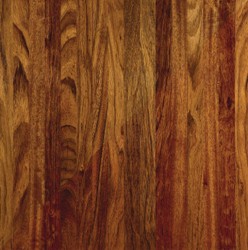
Top portion is finished with water-base finish; bottom with oil-based finish
Appearance
Color: Sapwood is gray-white; heartwood is salmon red to orange-brown when fresh, and becomes russet or reddish brown when seasoned; often marked with dark streaks.
Grain: Mostly interlocked; texture is medium to rather coarse.
Variations Within Species And Grades: Moderate to high color variation.
Workability
Sawing/Machining: Sawing is difficult due to high density; requires frequent resharpening of tools. Planing is difficult due to interlocked grain. Can be machined to a smooth surface. Carbide tooling recommended.
Sanding: Scratches are easily seen. Each sanding must carefully remove the scratches from the previous cut, or sanding marks will be visible in the finish.
Nailing: Due to hardness it is very important that the angle of penetration be adjusted carefully. If using a pneumatic nailer, the air pressure should be adjusted.
Finishing: Coating with oil-modified polyurethane may occasionally cause white spots or specks, as well as white end joints, to appear. This may be avoided by buffing in a clear oil sealer or neutral stain, then buffing on satin polyurethane.
Comments Origin: South America
Properties
Hardness/Janka: Comments Origin: South America
Dimensional Stability: Average (8.5; 1% more stable than Northern red oak). However, actual installations have shown significant movement. Longer-than-normal acclimation time is recommended.
Durability: Availability
Readily available.