
Check out the Hardwood Floors magazine Resource Book with more than 3,400 listings of manufacturers, distributors, and other NWFA members.
View Digital Edition
Douglas Fir Species
Back to Species Gallery
Species - Domestic
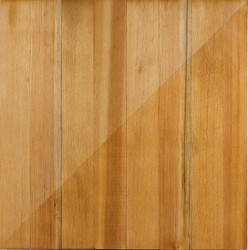
Top portion is finished with water-base finish; bottom with oil-based finish
Appearance
Color: Heartwood is yellowish tan to light brown. Sapwood is tan to white. Heartwood may be confused with that of Southern yellow pine. Radical color change upon exposure to sunlight.
Grain: Normally straight, with occasional wavy or spiral texture. Nearly all fir flooring is vertical-grain or rift sawn clear-grade material.
Variations: Wood varies greatly in weight and strength. Young trees of moderate to rapid growth have reddish heartwood and are called red fir. The narrow-ringed wood of old trees may be yellowish-brown and is known as yellow fir.
Workability
Sawing/Machining: Harder to work with hand tools than the soft pines.
Sanding: Sands satisfactorily if the correct sanding sequence is followed.
Nailing: Has a tendency to split the tongues.
Finishing: Some boards develop a slight pinkish to bright salmon color when finished with some products. Because of tendency toward color change, care must be taken to avoid oversanding when refinishing an existing floor. May be difficult to stain.
Comments Origin: North America
Properties
Hardness/Janka:660; (49% softer than Northern red oak).
Dimensional Stability: Above average (7.3; 15% more stable than Northern red oak)
Durability: Availability
Readily available.